
Wow, what was that? As a proud viola player, I'm all for the expansion of our limited repertoire, but this is one of those cases where the transcription just does not work. I first caught whiff of this recording back in January and was intrigued, to say the least. There are few recordings available of the Elgar on viola and the fact that the soloist is being accompanied by the phenomenal Philharmonia Orchestra under Christoph Eschenbach was enough for me to give this recording a try. This recording has garnered critical acclaim from reputable reviewers on The Strad and Gramophone Magazine, even winning the latter's Editor's Choice award for the October 2009 issue. After listening to the album straight through, I keep asking myself what those critics heard that I didn't.
There is no denying that David Aaron Carpenter is an amazing violist. A protégé of Pinchas Zukerman, this American took first place at the prestigious Walter E. Naumburg Viola Competition in 2006 and is the youngest Music Protégé selected in the Rolex Mentor and Protégé Arts Initiative. He plays with a big, silky tone and has technique comparable to the best of the best. Yet, even with those strengths at his disposal, his reading of the Elgar was a bit painful to listen to.
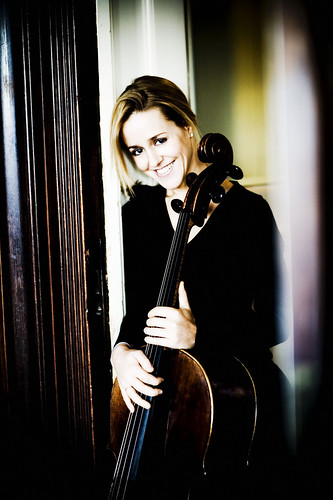
The Elgar, to me, is the concerto of a tragic hero, portrayed by the cellist. Weathered with life's brutal reality, the hero recounts his story for those who would stop to listen. The reason why the opening is so affecting is because the timbre of the sound is so guttural; the hero, out of silence, vehemently cries out in his recitative. It is full of masculinity, nobility, and, most importantly, vulnerability. All those qualities are lost when played on the viola. Even before a note is played, the viola is at an inherent disadvantage because the physical specifications of the instrument results in a tone production that is an octave above cellos. Therefore, instead of a man singing the recitative, we have, in effect, what sounds like a boy tenor trying to sing a man's part. Take a listen to the difference. For the cello comparison, I'm using the amazing recording by Sol Gabetta.
Sol Gabetta
David Aaron Carpenter
To me, this difference is significant enough that the concerto played on viola actually detracts from the musical quality of the piece. Another passage that sounded particularly jarring occurs in the last movement. There is a moment where the soloist joins the cello section for a few moments of unified, impassioned playing. What makes this section so moving in its original form is this shedding of the soloist aura in exchange for the the unifying forces of a section sound overwhelms the listener. When this moment came in Carpenter's recording, I was hoping that instead of joining the cellos, the transcription calls for the violist to join with the violas. No such luck, however, and the difference in timbre made the moment sound flat and underwhelming instead of powerful and epic.
Carpenter's playing in the Schnittke, on the other hand, is incredible. The difference is night and day. His aforementioned artistry, the silken tone and sure-handed technique, are on full display here. His incredibly even doublestop playing makes all the voices clear in dissonant counterpoint writing in the solo part. The wickedly difficult second movement is the highlight of the recording, with the garish episodes of uncouth and bitingly caustic music being brought off with conviction and passion.
In summary, this recording of the Schnittke has become my benchmark recording for the concerto, superior to time-tested readings by legendary violists such as Yuri Bashmet and Nobuko Imai. The Elgar, on the other hand, will probably not be listened to again.
Carpenter's playing in the Schnittke, on the other hand, is incredible. The difference is night and day. His aforementioned artistry, the silken tone and sure-handed technique, are on full display here. His incredibly even doublestop playing makes all the voices clear in dissonant counterpoint writing in the solo part. The wickedly difficult second movement is the highlight of the recording, with the garish episodes of uncouth and bitingly caustic music being brought off with conviction and passion.
In summary, this recording of the Schnittke has become my benchmark recording for the concerto, superior to time-tested readings by legendary violists such as Yuri Bashmet and Nobuko Imai. The Elgar, on the other hand, will probably not be listened to again.


 . So I approached the recording more out of curiosity rather than trying to find a Goliath-slaying interpretation that would usurp du Pr
 . My favorite recording of Tchaikovsky's Rococo Variations and Saint-Saens Cello Concerto No.1 has been, for the past 10 years,